This is part one of a three-part series for International Women’s Day 2026.
See Part 1 – See Part 2 – See Part 3
Historically comprised mostly of men and impacted by cultural barriers, the automotive industry has undergone an evolution that transcends the technology of production lines. In this blog post, two women from Volkswagen and Benteler Brazil share their perceptions of the changes in our sheet metal stamping and BiW assembly industry to include more women, reflecting the reality of the modern consumer. Where are we today, and are women represented at higher levels?

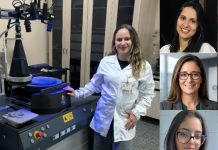
Gabriela Fernandes Diogo – Tooling Supervisor
Volkswagen: Gabriela Fernandes Diogo
The trajectory of Gabriela Fernandes Diogo at Volkswagen, which began in 2009 via the Technical Center (SENAI), exemplifies the complex intergenerational dynamics faced by women in environments historically considered masculine. Her career progression from toolmaker to supervisor reveals that one of the challenges for women in the industry is the combination of gender and age factors.
Gabriela reports that, upon assuming leadership, youth became a challenging factor: “It was always common for me to be the youngest leader/supervisor at the tables where I sat for discussions, and I felt I needed to prove myself more than the others.” In the context of coexistence between generations, she observes a profound structural change. If at the beginning of her career the female presence on the “shop floor” was almost nonexistent, today she witnesses the integration of dozens of women in the workshop.Gabriela points out that the generational exchange is enriching, but demands firmness: “The important thing is to have an argument. If you have a grounded argument, if you can prove it with numbers or evidence, you gain strength. Against facts, there are no arguments.” Out of a team composed of 11 supervisors, currently only she and one other woman hold the positions. Therefore, she views her position with a responsibility to “open doors” for her successors.
Concluding with an eye towards the future, Gabriela offers strategic advice for the younger generation of women who aspire to leadership, based on three pillars that she considers crucial:
- Preparation and vision: It is essential to be technically prepared and to communicate where one wants to go. “If you are lost and not even you know what you want, you don’t know how to ask others for help.” “Be technically prepared, whether in a language, a technical course, a specialization, work towards your goals, because when opportunity knocks on your door, you will be prepared.”
- Networking: Cultivating good relationships is decisive to be seen as a potential within the company.
- Resilience: Maintaining confidence in one’s own merit to not allow prejudices to invalidate your achievements. “Someone might say: ‘She was promoted only because the company adhered to the quota for women in leadership.’ In these cases, it is important to be firm and position yourself by answering: ‘I was promoted because I was identified with potential, I am competent, and I was prepared for this.'”
Amanda Celeste – Junior Process Analyst
Benteler: Amanda Celeste
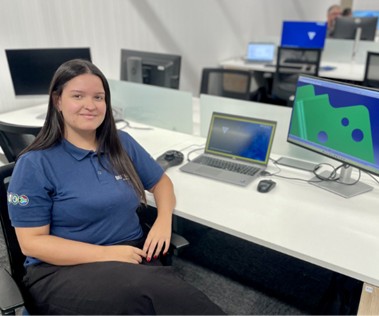
If Gabriela’s leadership consolidates the female space, Amanda’s trajectory reveals the daily and structural victories of those who begin their careers in today’s industry. A recently graduated mechanical engineer, Amanda carries the weight of blazing trails in her journey at Benteler, at the Campinas unit: she was the first woman to hold the position of apprentice, then intern, and now, the first to be hired full-time in the Manufacturing Engineering sector. This track record of being “the first” in several stages reflects both the progress of the area and the responsibility of opening paths: “I was the first female apprentice in the tooling shop… and now as a full-time employee, I feel that my team has full confidence in my work, but outside this bubble, I still face resistance.”
One of the most sensitive and symbolic points of her narrative is the issue of infrastructure, something that goes unnoticed by most men, but that defines the market’s preparation for the rise of women in the manufacturing environment. Amanda reported a logistical difficulty regarding something basic that she faced in the past: access to restrooms, something common in older industrial structures. “There was a time when, to use a women’s restroom, I had to cross the entire factory and go to the administrative building.” For her, the physical adaptation of the industry is a direct reflection of the female presence; if there are no nearby restrooms, the implicit message is that that space was not designed for them.
In addition to the physical barriers, Amanda identifies a cultural lag that pushes young women away from Mechanical Engineering: the idea that the work is exclusively “manual” or “dirty.” She insists on demystifying this view to attract new talents: “Many people still see mechanical engineering only as manual labor and associate it with tightening screws or getting their hands dirty with grease, but I work with simulation, something extremely technical and intellectual. I would like them to have more information about this; it is not just physical strength, it is intelligence, strategy, and technology. If they knew how broad the area is and the thousands of possibilities there are, more women would be interested.”
Even facing challenges in the job market, Amanda reinforces that security and technical knowledge are her greatest defence. For her, this occasion is a reflection of an external industry that still finds it strange to see a young woman in charge of technical decisions. She summarizes her posture strategically: “I avoid focusing on the fact that I am a woman or young so as not to feed this prejudice inside me. I try to focus on the relationship and on the mastery of what I do so that the person feels secure dealing with me, demonstrating that I am capable.”
Amanda also left advice of three pillars that she considers fundamental for the new generation:
- Information: Understanding that mechanical engineering offers careers in high technology and simulation, going far beyond physical effort or the “shop floor”.
- Resilience: Recognizing that occupying spaces is part of the transformation of industrial culture, and we need to work towards that.
- Confidence and technical knowledge: Building a solid foundation of knowledge so that any type of prejudice is combated with unquestionable results.