Introduction
Fuji Technica & Miyazu Inc. is a leading automotive tool manufacturer based in Shizuoka and Gunma, Japan. The company has a strong reputation among major automakers both in Japan and around the world. It also has overseas offices to better serve its customers.

Mishima Plant, Fuji Technica & Miyazu
Fuji Technica & Miyazu is a well-established tooling manufacturer with a 67-year history. Throughout that time, it has supplied high-quality tools to customers around the world.
With its motto of “creating tools that leave competitors behind,” the company strives to be the world’s leading tooling manufacturer by combining large-scale press capabilities with outstanding quality, cost, and delivery.
Fuji Technica & Miyazu is also known for its commitment to innovation. It was the first company in Japan’s automotive tooling industry to implement a CAD/CAM system. In 1979, the company took a major step toward digitalization by introducing CAD/CAM technology. Engineers probe-scanned a master model to generate numerical data for milling. Although the implementation presented many challenges, they overcame them through extensive trial and error. Over time, CAD/CAM became fully integrated into the workflow, replacing hand-drawn designs with digital ones. Previously, the entire process from die layout to shipping could take up to two years. CAD/CAM dramatically reduced both production time and cost.
Digitalizing the Tooling Process
Fuji Technica & Miyazu adopted AutoForm, the press-forming simulation software, at an early stage in 1997. It was only the second company in Japan to implement AutoForm, at a time when the software was still virtually unknown in the country.
Mr. Shimizu, CAE Team Leader in the Process Design Group, explains: “Automakers in Japan usually conduct preliminary studies and even provide die face designs when ordering a tool. In contrast, overseas automakers often order the complete package, including the process plan and die face design. In these cases, we rely on AutoForm because the calculations are significantly faster. In particular, AutoForm-DieDesigner makes creating tool geometry fast and straightforward.”

From left: CAE team leader Kosuke Shimizu, Liu Chun Jie, and Yuji Uematsu, Process Design Group
Improving Process Planning
When Fuji Technica & Miyazu introduced AutoForm, there was little internal resistance. At the time, process layouts and tool geometry for domestic customers were created from 2D section geometry based on the customer’s stamping specifications. However, extensive rework was often required after 3D modeling. To reduce this rework, the company recognized the need to identify and address major issues much earlier in the engineering process. Since 2002, AutoForm has been fully integrated into the company’s process planning workflow, helping engineers identify and resolve potential issues before they require costly rework.

Benefits of implementing AutoForm-DieDesigner
When defining die layouts, creating CAD geometry, and running simulations, engineers often need to modify the geometry after discovering that the CAD model no longer matches the intended die layout or that tipping has a significant impact on skid or shock lines. Previously, this meant repeatedly modifying CAD geometry and repeating the engineering process.
With AutoForm’s CATIA work environment, even engineers with limited CAD experience can create tool geometry. A single engineer can now manage die layout, CAD geometry, and simulation within one software environment. This significantly reduces repetitive engineering work and lowers overall engineering hours.

Man-hours for AutoForm-DieDesigner and Modeling
When part geometry changes, which frequently happens during the early stages of vehicle development, AutoForm’s CATIA work environment enables engineers to modify tool geometry much faster than conventional CAD. When multiple process or geometry options are available, engineers can evaluate several alternatives through simulation in a short period of time, allowing optimal decisions to be made sooner. More comprehensive analysis also improves the quality of the milling data. Fuji Technica & Miyazu has continued refining this workflow for more than 20 years.
Today, the company continues to improve both quality and engineering efficiency. AutoForm-DieDesigner reduces the engineering hours required for each part, allowing engineers to handle more work while delivering higher-quality results. As a result, Fuji Technica & Miyazu has earned the trust of customers in Japan and around the world.

CAE team, Process Design Group, Oizumi region. From left: Kazuaki Kubota, Kazuhiro Shimizu, and Yoshinori Sumiya
Continuous Improvement Through Measurement
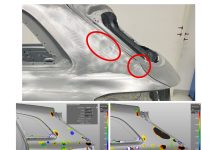
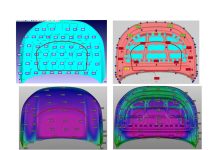
Technical innovation continues throughout Fuji Technica & Miyazu. One example is the implementation of a non-contact 3D panel scanning system. While it is common to scan panels produced during tryout, Fuji Technica & Miyazu scans panels from every tryout and every process stage. This allows engineers to review the complete history of each panel and identify exactly where defects originate. By pinpointing the influencing factors, they can develop more effective countermeasures.
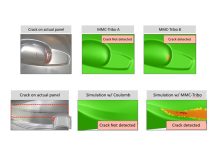
The company also compares 3D scan data with simulation results to identify areas where simulation differs from reality. These findings are fed back into future simulations, continuously improving simulation accuracy while strengthening the company’s engineering expertise.
Robustness Analysis
In recent years, Fuji Technica & Miyazu has expanded its process optimization work using AutoForm-Sigma.

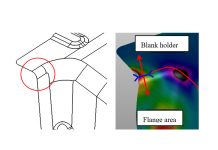
One example involves a hood component. During the stamping process, springback must be minimized when bending the flange. Fuji Technica & Miyazu is using AutoForm-Sigma to determine the optimal entry timing for the bending die.
The software’s robustness analysis runs multiple simulations across a defined range of parameters, including bending die entry timing, draw operation tool pressure, and tool gap throughout the process. Evaluating this range of conditions reveals how strongly each parameter influences defects, enabling engineers to identify the optimal bending die entry timing for each application.
Through its continued investment in advanced manufacturing technologies, Fuji Technica & Miyazu continues to lead the tooling industry. Guided by its motto of “creating tools that leave competitors behind,” the company remains committed to delivering world-class tooling with exceptional quality, cost, and delivery performance.

Company Overview
Fuji Technica Miyazu Co., Ltd.
Established: February 1957
Headquarters & Mishima Plant: 20 Matoba, Shimizu-cho, Sunto-gun, Shizuoka
Representative: Hiroshi Hasegawa, President and Representative Director
Capital: 1 billion yen
Sales: 7 billion yen (fiscal year ending March 2023)
Number of Employees: 397 (as of September 2023)
Domestic Plants: Mishima Plant, Izu Nagaoka Plant, Oizumi Plant
Overseas Locations: [North America] Fuji Technica & Miyazu America
[China] Yantai Fuji Wilson Engineering
[Asia] PT Fuji Technica Indonesia
Business Activities: Manufacturing of automotive press dies, automotive interior dies, construction machinery and building material dies, inspection jigs, and the provision of various technical services.
URL: https://fuji-miyazu.co.jp/